




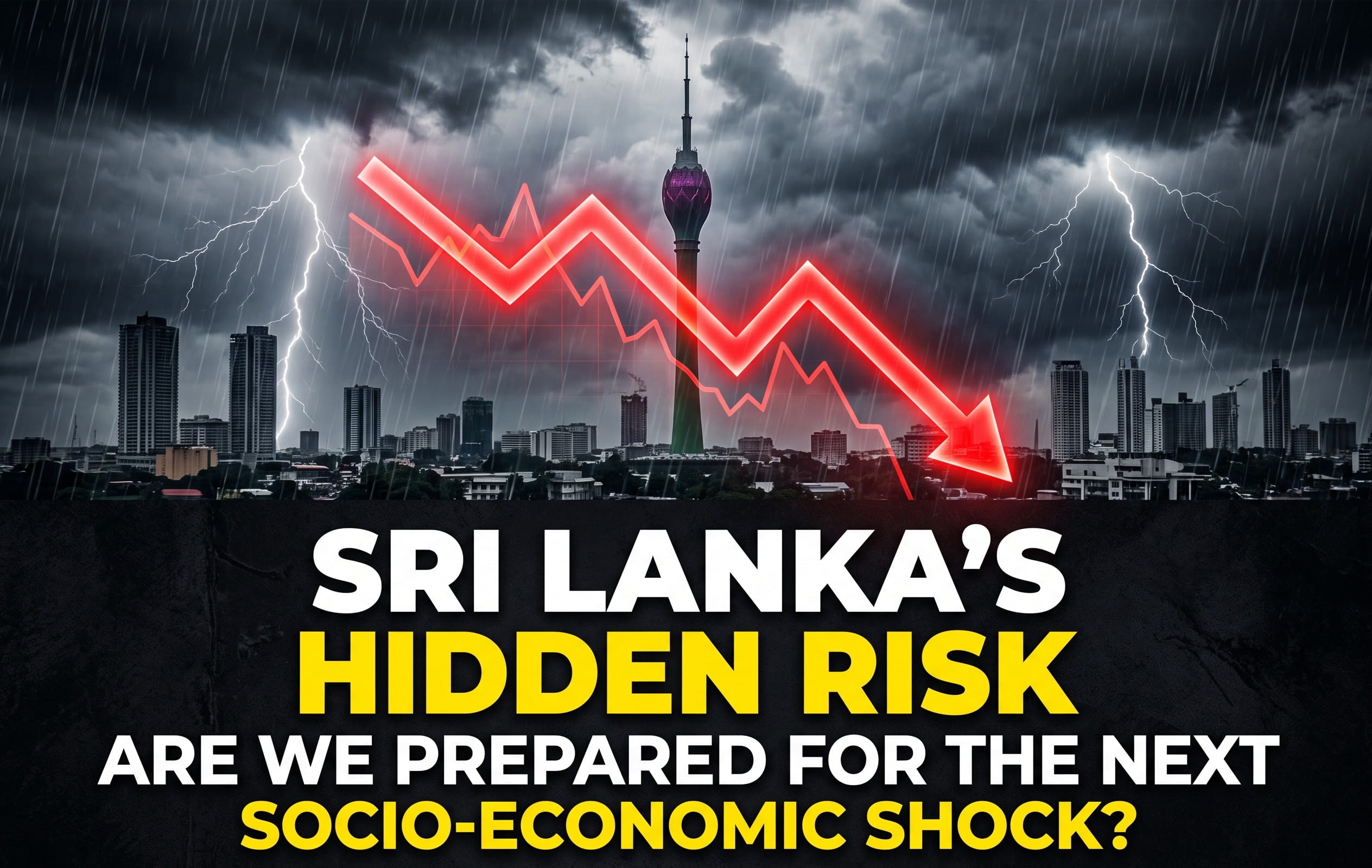
Sri Lanka's Hidden Risk: Are We Prepared for the Next Socio-Economic Shock❓
Sri Lanka has undergone enough crises including Cyclone Ditwah, which was far more than a natural disaster to understand the cost of being unprepared. It breeds a question the country can no longer afford to postpone: “are we preparing for the next shock, or simply becoming better at responding to the last one?” The next disruption may not come as another economic crisis; it could emerge from extreme weather, public-health emergencies, food and energy disruptions, or several pressures occurring simultaneously. What matters, therefore, is not simply how well Sri Lanka responds after a crisis, but how prepared it is before one occurs. Sri Lanka’s this practice needs to be changed through applying proper planning techniques.
Global climate situations are changing, and the emergence of El Niño in 2026 could alter rainfall and temperature patterns across regions. Sri Lanka is also still confronting the effects of recent major disasters. Meanwhile, the country is firming up emergency preparedness in areas such as disaster management and health security. These expansions are encouraging, but they also highlight a larger issue: preparedness cannot remain primarily an institutional responsibility.
A National Emergency Plan (NEP) may define who should respond, but the real consequences of a shock are experienced by households, communities, businesses, schools, hospitals and local authorities. A family without financial reserves, a community without reliable early-warning communication, a hospital with limited emergency capacity, or a small business unable to operate after a disruption can turn a temporary shock into a prolonged socio-economic problem.
This is where Sri Lanka's vulnerability deserves greater attention. Preparedness should therefore be measured beyond the existence of national plans and emergency institutions. Can vulnerable households maintain access to food, healthcare and essential services during disruption? Can critical infrastructure continue operating? Can local authorities respond quickly? Can health services manage a sudden and unexpected increase in demand? Can communities receive and act upon early warnings? And can the government provide timely backing without placing extra pressure on already constrained public finances?
These questions point towards a wider understanding of national readiness. Disaster awareness, health preparedness, economic preparedness and social protection cannot be treated as separate policy areas. A major shock can move rapidly across these boundaries: a climate event can interrupt transportation, which affects food supplies, raises prices, reduces household income and places further pressure on health and social services.
Sri Lanka therefore needs to move beyond a culture of responding after a crisis and strengthen a culture of preparing before one. This means investing not only in emergency response capacity, but also in resilient infrastructure, reliable early-warning systems, local-level preparedness, health-system capacity, social protection and community awareness.
The greatest hidden risk may not be the next shock itself. Shocks are inevitable. The greater risk is allowing preventable vulnerabilities to turn a manageable shock into another national crisis. Sri Lanka cannot predict every shock, but can prepare for its consequences following appropriate planning techniques.
Manoja Alweera
MCPM, PhD (Reading) UOC,
MBA (RUSL), B.Sc. in Mgt. (UCD, Ireland),
ANDHRM (NIBM, SL), DAE (UOC)
Manager - Research and Development
The Institute of Chartered Accountant of Sri Lanka